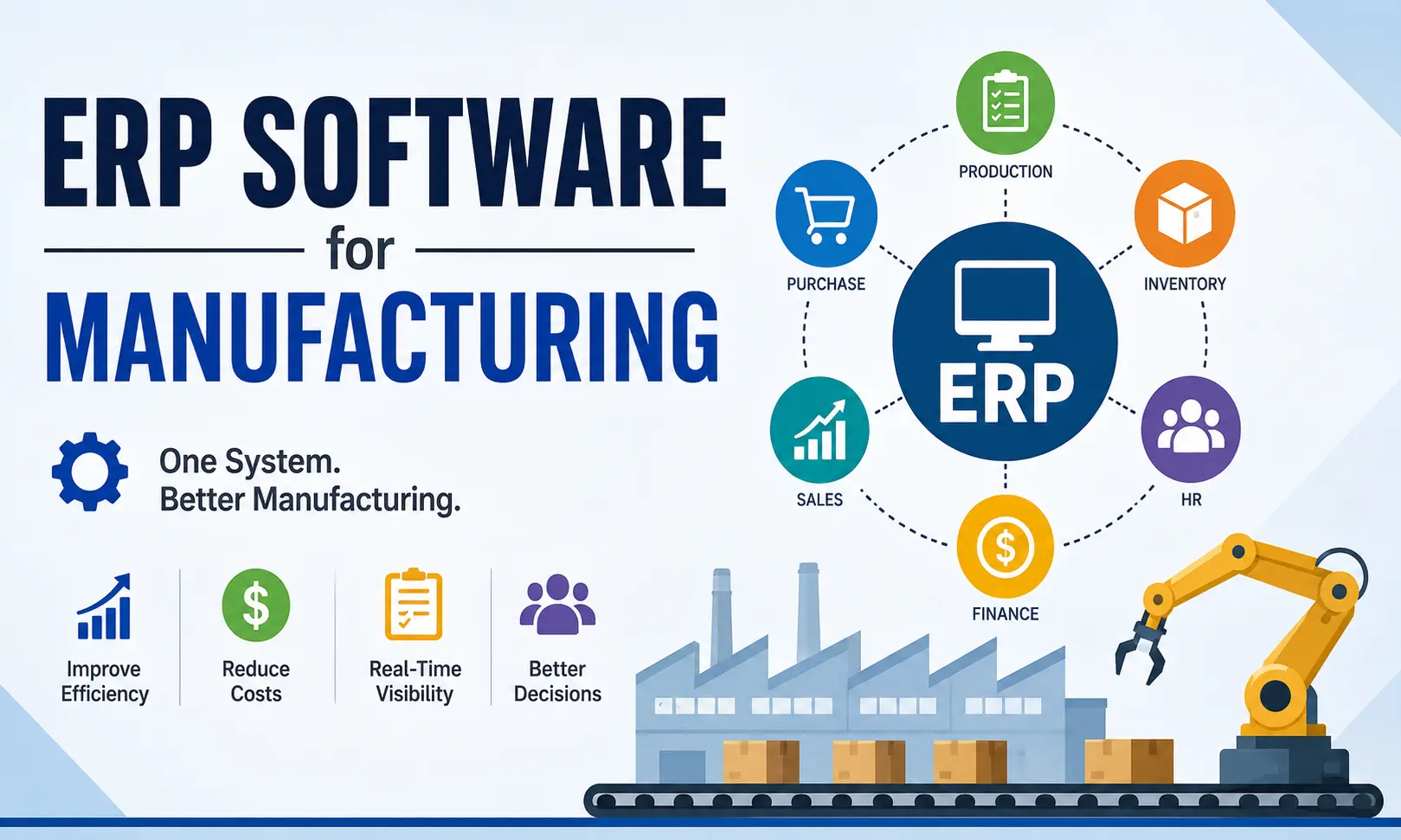
In the modern manufacturing industry, efficiency is no longer just about producing more products in less time. Manufacturers also need to control costs, maintain product quality, manage inventory, deliver orders on time, and respond quickly to changing customer expectations. When these activities are managed through disconnected software, spreadsheets, and manual processes, even a small error can create delays across the entire production cycle.
This is where ERP software for manufacturing can make a significant difference.
Enterprise Resource Planning, commonly known as ERP, brings important business processes together on a single integrated platform. From purchasing raw materials and planning production to managing inventory, finances, sales, and customer orders, ERP software allows manufacturers to manage their operations from one centralized system.
More importantly, ERP does not simply replace paperwork with software. It helps businesses connect their departments, automate repetitive tasks, access real-time information, and make smarter decisions. For manufacturers looking to improve productivity and achieve sustainable growth, ERP has become an increasingly valuable technology.
What Is ERP Software in Manufacturing?
ERP software is a business management system that integrates different organizational functions into one platform. In a manufacturing environment, an ERP solution can manage production planning, inventory, procurement, supply chain operations, quality control, sales, accounting, human resources, and reporting.
For example, imagine that a customer places a large order. In a traditional system, the sales team may need to contact the inventory department, which then checks the warehouse manually. The production team may then need to determine whether enough raw materials and machine capacity are available.
With an ERP system, much of this information is connected. The system can provide visibility into inventory, production capacity, pending orders, material requirements, and other relevant information. This allows employees to work with the same data and reduces unnecessary communication delays.
Why Is Manufacturing Efficiency So Important?
Manufacturing businesses operate on tight schedules and margins. A delay in one area can quickly affect other operations. For example, if raw materials arrive late, production may stop. If production is delayed, deliveries may be postponed. Delayed deliveries can eventually affect customer satisfaction and revenue.
Manufacturing efficiency means using available materials, machines, employees, time, and money as effectively as possible.
ERP software helps manufacturers improve these areas by connecting data and processes.
| Manufacturing Challenge | How ERP Can Help |
|---|---|
| Production delays | Better production planning and scheduling |
| Material shortages | Real-time inventory monitoring |
| Excess inventory | Better demand and purchasing planning |
| Manual data entry | Process automation |
| Supplier delays | Centralized procurement tracking |
| Quality problems | Quality control and production records |
| Poor decision-making | Real-time reports and analytics |
| High operating costs | Better resource and cost management |
1. Improves Production Planning and Scheduling
Production planning is one of the most important functions in a manufacturing company. Without accurate planning, machines may remain idle, employees may not be utilized properly, and production orders may miss their deadlines.
Manufacturing ERP software helps managers create production schedules based on available resources, customer orders, raw materials, machine capacity, and workforce availability.
Suppose a factory receives 500 orders that need to be completed within two weeks. The ERP system can help management understand what materials are available, what needs to be purchased, which machines are available, and how production can be scheduled.
This makes production planning more organized and reduces bottlenecks.
2. Better Inventory Management
Inventory is one of the biggest areas where manufacturers can either save or lose money. Keeping too much inventory increases storage and holding costs, while insufficient inventory can stop production.
ERP software provides real-time visibility into inventory levels. Businesses can monitor raw materials, work-in-progress items, finished goods, and stock movements through a centralized system.
The system can also help identify when materials need to be reordered based on predefined requirements and business conditions.
This means manufacturers can maintain healthier inventory levels instead of depending entirely on manual stock checking.
Benefits of ERP for Inventory Management
| Feature | Benefit |
|---|---|
| Real-time stock tracking | Reduces inventory-related errors |
| Automated stock updates | Saves manual effort |
| Material requirement planning | Reduces chances of shortages |
| Warehouse visibility | Improves stock control |
| Inventory reports | Supports better purchasing decisions |
3. Reduces Manual Work and Human Errors
Manufacturing companies generate a huge amount of information every day. Employees may have to enter purchase orders, inventory movements, production data, invoices, sales information, and financial transactions.
When these activities are performed manually, the possibility of errors increases.
ERP software automates many repetitive processes and allows information to move between connected departments. For instance, when a sales order is entered, relevant inventory and production information can be updated within the system.
Less manual data entry means employees spend less time on repetitive administrative tasks and more time on activities that directly improve business performance.
4. Strengthens Supply Chain Management
A manufacturing company cannot operate efficiently without a reliable supply chain. Raw materials must reach the factory at the right time, in the right quantity, and at the required quality.
ERP software helps businesses manage suppliers, purchase orders, material requirements, delivery schedules, and procurement records from a centralized platform.
Managers can gain better visibility into supplier performance and purchasing activities. This makes it easier to identify recurring delivery problems and take corrective action.
An efficient supply chain also reduces the risk of production stoppages caused by missing materials.
5. Helps Reduce Manufacturing Costs
Every manufacturer wants to reduce unnecessary expenses without compromising product quality. ERP software can contribute to cost reduction by providing better control over inventory, labor, purchasing, production, and other operational activities.
For example, if a business discovers through ERP reports that a particular product consistently consumes more raw materials than expected, management can investigate the reason.
Similarly, production data can help identify excessive downtime, inefficient processes, or unnecessary inventory expenses.
The objective is not simply to spend less. It is to understand where resources are being consumed and use them more efficiently.
6. Improves Quality Control
Quality problems can be expensive for manufacturers. Defective products can lead to rework, wastage, returns, customer complaints, and reputational damage.
ERP software can help organizations establish quality checks at different stages of production. Quality inspection results, batch information, material details, and production records can be maintained within the system.
If a quality issue occurs, managers can analyze available production information and identify where the problem may have originated.
This supports a more systematic approach to quality management and continuous improvement.
7. Provides Real-Time Manufacturing Data
One of the most valuable advantages of ERP software is access to real-time information.
In traditional systems, managers may have to wait for different departments to prepare reports. By the time the information reaches management, the situation may already have changed.
With ERP, authorized users can access updated information related to production, inventory, orders, procurement, sales, and finances.
For example, a production manager can quickly check whether an order is progressing according to schedule rather than waiting for a daily or weekly report.
Real-time data makes decision-making faster and more practical.
8. Improves Communication Between Departments
Manufacturing is a team effort. Production, purchasing, sales, finance, warehouse, quality control, and management all depend on each other.
When departments maintain separate records, communication gaps can occur.
ERP creates a shared digital environment where relevant employees can access the same business information according to their permissions. This reduces duplicate data, improves coordination, and makes cross-department communication easier.
For example, the sales department can get better visibility into product availability, while the purchasing team can understand upcoming material requirements.
9. Enhances Order Management and Customer Satisfaction
Customers expect accurate information and timely deliveries. Even a small delay can affect customer trust, particularly in industries where production schedules are closely connected to supply chains.
ERP software connects sales orders with inventory and production information. This makes it easier for businesses to understand whether an order can be fulfilled immediately or requires additional production.
Customer service teams can also provide more accurate information about order status and expected delivery dates.
As a result, ERP can indirectly contribute to better customer satisfaction and stronger business relationships.
10. Helps Businesses Make Data-Driven Decisions
Good business decisions require reliable information. ERP software collects data from different business functions and converts it into reports, dashboards, and performance indicators.
Managers can analyze information such as:
- Production output
- Inventory turnover
- Material consumption
- Order fulfillment
- Production costs
- Supplier performance
- Machine downtime
- Sales performance
- Profitability
Instead of relying only on assumptions or outdated spreadsheets, management can use actual business data to identify trends and improve processes.
ERP Software and Manufacturing Efficiency: A Quick Comparison
| Without ERP | With ERP |
|---|---|
| Multiple disconnected systems | Integrated business platform |
| Manual data entry | Automated workflows |
| Delayed reports | Real-time information |
| Difficult inventory tracking | Centralized inventory visibility |
| Communication gaps | Connected departments |
| Manual production planning | Data-based scheduling |
| Higher risk of errors | Improved data accuracy |
| Limited business visibility | Centralized dashboards and reports |
11. Supports Preventive Maintenance
Machine downtime can seriously affect manufacturing productivity. When an important machine stops unexpectedly, production schedules can be disrupted and delivery deadlines may be missed.
ERP systems with maintenance capabilities can help businesses maintain equipment records, schedule maintenance activities, and track maintenance history.
Instead of waiting for equipment to fail, manufacturers can plan maintenance activities in advance.
This can help reduce unexpected downtime and extend the useful life of important machinery.
12. Makes Manufacturing More Scalable
As a manufacturing business grows, its operations become more complex. More customers, products, suppliers, employees, warehouses, and production locations can make manual systems increasingly difficult to manage.
ERP software provides a structured platform that can grow with the organization. Depending on the solution, businesses can add users, modules, locations, processes, and integrations as their requirements increase.
This makes ERP particularly useful for manufacturers planning long-term expansion.
The Role of ERP in Industry 4.0
The manufacturing industry is moving toward Industry 4.0, where technologies such as automation, artificial intelligence, IoT, cloud computing, robotics, and data analytics are becoming increasingly important.
ERP software can act as a central business platform that connects information from different systems and processes.
For example, data generated by connected machines can potentially be combined with production and business information to provide deeper insights into factory performance.
Cloud ERP solutions can also allow authorized employees to access business information from different locations, supporting remote collaboration and multi-location operations.
Key Benefits of ERP Software for Manufacturers
A well-implemented ERP system can provide benefits across almost every major area of manufacturing.
| Area | Expected Improvement |
|---|---|
| Production | Better planning and scheduling |
| Inventory | Greater stock visibility |
| Procurement | Better supplier and purchasing management |
| Finance | Improved cost and financial tracking |
| Quality | More organized inspection and quality records |
| Supply Chain | Better coordination and visibility |
| Workforce | Improved resource planning |
| Sales | Faster and more accurate order processing |
| Reporting | Faster access to business insights |
| Maintenance | Better equipment planning |
How to Choose the Right ERP Software for Manufacturing
Selecting an ERP system is an important decision because every manufacturing business has different requirements. A solution suitable for a small factory may not necessarily be suitable for a large multi-location manufacturer.
Before selecting ERP software, businesses should evaluate production processes, inventory requirements, number of users, integration needs, reporting requirements, scalability, security, implementation support, and total cost.
It is also important to involve employees who will actually use the system. Their feedback can help identify practical requirements and reduce resistance during implementation.
The goal should not be to purchase the software with the longest list of features. Instead, manufacturers should select a solution that solves their actual operational problems and can support future growth.
Conclusion
ERP software is transforming the way modern manufacturing businesses manage their operations. By connecting production, inventory, procurement, finance, sales, quality control, maintenance, and other functions, ERP creates a more organized and transparent business environment.
The biggest advantage is that manufacturers no longer have to depend entirely on disconnected spreadsheets, manual processes, and delayed reports. They can access more reliable information, automate repetitive tasks, improve resource utilization, control inventory, reduce costs, and make faster decisions.
However, ERP is not a magic solution that automatically fixes every manufacturing problem. Successful implementation requires proper planning, employee training, accurate data, process improvements, and ongoing management support.
When the right ERP software is selected and implemented effectively, it can become much more than an accounting or inventory system. It can serve as the digital backbone of a manufacturing business and help the organization become more efficient, flexible, data-driven, and ready for future growth.
Frequently Asked Questions (FAQs)
What is ERP software in manufacturing?
ERP software in manufacturing is an integrated business management system that connects processes such as production planning, inventory, procurement, finance, sales, quality control, and supply chain management on one platform.
How does ERP improve manufacturing efficiency?
ERP improves manufacturing efficiency by automating repetitive processes, improving production planning, providing real-time inventory information, reducing data errors, controlling costs, and helping managers make data-driven decisions.
Can ERP reduce manufacturing costs?
Yes. ERP can help reduce costs by improving inventory management, minimizing waste, reducing manual work, improving resource utilization, and providing better visibility into production and operational expenses.
Is ERP suitable for small manufacturing businesses?
Yes. ERP solutions are available for businesses of different sizes. Small manufacturers can choose scalable solutions that meet their current requirements and expand as the business grows.
What are the main benefits of ERP for manufacturing?
The major benefits include better production planning, inventory control, supply chain management, quality control, cost management, real-time reporting, improved collaboration, and faster decision-making.
Is ERP important for Industry 4.0?
Yes. ERP can play an important role in digital manufacturing by connecting business processes with technologies such as IoT, automation, cloud platforms, analytics, and other Industry 4.0 systems.