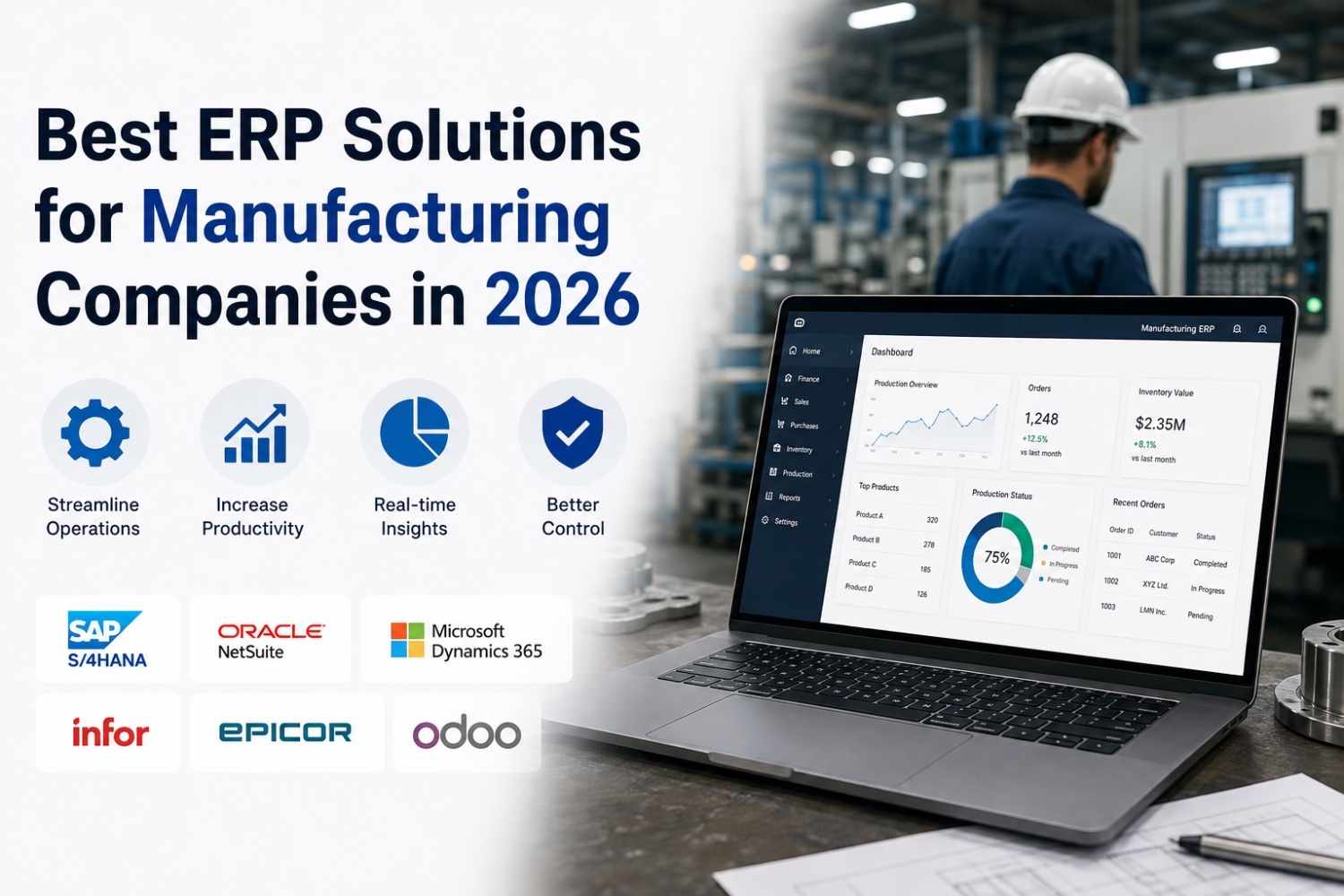
Manufacturing businesses are becoming more complex every year. Companies need to manage production schedules, raw materials, inventory, suppliers, employees, quality control, finances, customer orders, and delivery timelines—all while keeping costs under control.
Managing these activities through spreadsheets and disconnected software can quickly become difficult as a company grows. This is why ERP software for manufacturing companies has become an important part of modern business operations.
A manufacturing ERP system brings different departments and processes together in one centralized platform. It can help businesses improve production planning, automate routine tasks, monitor inventory, manage procurement, control costs, and make decisions using real-time data.
But with so many ERP solutions available, choosing the right one can be challenging.
In this guide, we will look at some of the best ERP solutions for manufacturing companies in 2026, their strengths, ideal use cases, and the factors businesses should consider before making a decision.
What Is Manufacturing ERP Software?
Manufacturing ERP software is an integrated business management solution designed to handle the specific requirements of manufacturing organizations.
Unlike a basic accounting or inventory system, a manufacturing ERP can connect areas such as:
- Production planning
- Material Requirements Planning (MRP)
- Bill of Materials (BOM)
- Inventory management
- Procurement
- Supply chain management
- Quality management
- Warehouse management
- Financial management
- Sales and order management
- Maintenance
- Workforce management
- Business reporting and analytics
The biggest advantage is that these functions can work together using centralized business data.
For example, when a customer places an order, the ERP system can help determine inventory availability, material requirements, production capacity, and expected delivery timelines. This connected approach can reduce delays and improve overall operational efficiency.
Best ERP Solutions for Manufacturing Companies
The following ERP platforms are among the major solutions considered by manufacturers in 2026. The right choice depends on company size, manufacturing type, budget, existing technology, and future growth plans.
| ERP Solution | Best For | Manufacturing Strength |
|---|---|---|
| SAP S/4HANA | Large and global manufacturers | Very strong |
| Microsoft Dynamics 365 | Mid-size and large companies | Strong |
| Oracle NetSuite | Growing and cloud-first businesses | Strong |
| Infor CloudSuite | Industry-specific manufacturing | Very strong |
| Epicor Kinetic | Discrete and make-to-order manufacturing | Very strong |
| Acumatica | Growing mid-size manufacturers | Strong |
| SYSPRO | Small and mid-size manufacturers | Strong |
| Odoo | Small businesses and startups | Good |
1. SAP S/4HANA
Best for: Large, complex and global manufacturing companies
SAP S/4HANA is one of the most comprehensive ERP platforms available for large organizations. It is particularly suitable for manufacturers managing complex production environments, multiple locations, international operations, and sophisticated supply chains.
The platform supports areas such as production planning, quality management, inventory, procurement, maintenance, finance, and supply chain operations. Current manufacturing comparisons continue to place SAP among the strongest options for large and complex manufacturers.
Key Advantages
- Deep manufacturing functionality
- Strong production planning
- Supply chain management
- Quality management
- Asset and maintenance capabilities
- Global business support
- Advanced analytics and AI capabilities
- Suitable for complex multi-plant operations
Who Should Choose SAP?
SAP S/4HANA is generally more appropriate for large enterprises with complex requirements rather than small manufacturers looking for a simple and affordable ERP solution.
2. Microsoft Dynamics 365
Best for: Manufacturers already using the Microsoft ecosystem
Microsoft Dynamics 365 is another major ERP option for manufacturing organizations. It can be particularly attractive to businesses already using Microsoft products and services.
Its ecosystem can connect ERP operations with tools such as Microsoft 365, Teams, Power BI, and other Microsoft technologies. Manufacturing capabilities include supply chain management, production planning, inventory management, procurement, and financial operations.
Key Advantages
- Strong manufacturing capabilities
- Integration with Microsoft ecosystem
- Business intelligence through Power BI
- Cloud and hybrid options
- Supply chain management
- Scalable for growing businesses
For organizations already invested heavily in Microsoft technology, Dynamics 365 can provide a familiar and connected environment.
3. Oracle NetSuite
Best for: Fast-growing and cloud-first manufacturers
Oracle NetSuite is a cloud-based ERP platform widely considered by growing businesses that want to manage financials, inventory, operations, and manufacturing from one system.
It can be a practical choice for companies expanding into multiple locations or markets and looking for a cloud-first platform.
Key Advantages
- Cloud-based architecture
- Financial management
- Inventory management
- Manufacturing capabilities
- Procurement
- Order management
- Business reporting
- Support for growing organizations
NetSuite is often positioned as a strong option for mid-market companies that want cloud ERP without moving immediately into a very large enterprise implementation.
4. Infor CloudSuite Industrial
Best for: Industry-specific and complex manufacturing
Infor CloudSuite is designed with a strong focus on industry-specific business requirements. Its manufacturing capabilities make it particularly relevant for organizations with complex production processes.
The platform can support production, planning, inventory, supply chain, quality, and other operational functions.
Key Advantages
- Strong manufacturing functionality
- Industry-specific capabilities
- Cloud deployment
- Production planning
- Supply chain management
- Quality management
- Support for complex manufacturing environments
Infor is particularly worth considering when a manufacturer needs deeper industry functionality rather than a generic business management system.
5. Epicor Kinetic
Best for: Discrete, make-to-order and engineer-to-order manufacturers
Epicor Kinetic has a strong reputation in the manufacturing segment, particularly among discrete manufacturers, job shops, and make-to-order businesses.
It provides tools for production planning, scheduling, inventory, supply chain management, financials, quality, and shop-floor visibility.
Key Advantages
- Manufacturing-focused ERP
- Strong discrete manufacturing support
- Production scheduling
- Inventory management
- Quality management
- Shop-floor visibility
- Cloud, on-premise and hybrid options
For a mid-sized manufacturer that needs deep manufacturing functionality without necessarily adopting a large enterprise platform, Epicor Kinetic can be a strong option.
6. Acumatica
Best for: Growing manufacturers looking for flexibility
Acumatica is a cloud ERP platform that is often considered by growing and mid-sized businesses. Its manufacturing capabilities include production management, inventory, purchasing, sales, financial management, and other business processes.
One of its notable characteristics is its flexible licensing approach, which can be attractive to organizations where many employees need access to ERP information.
Key Advantages
- Cloud-based ERP
- Manufacturing management
- Inventory and warehouse management
- Financial management
- Flexible scalability
- Integration capabilities
- Suitable for growing businesses
Acumatica has also expanded its presence in India, including a new engineering-focused Global Capability Centre in Hyderabad in 2026.
7. SYSPRO
Best for: Small and mid-sized manufacturing businesses
SYSPRO focuses strongly on manufacturing and distribution businesses. It can be considered by companies that want manufacturing-specific ERP capabilities without necessarily adopting a very large enterprise platform.
It supports areas such as production, inventory, procurement, supply chain, financials, and business reporting.
For smaller manufacturers, the key attraction can be having dedicated manufacturing functionality while maintaining a relatively manageable implementation scope.
8. Odoo
Best for: Small manufacturers and startups
Odoo is a modular business management platform that provides applications for manufacturing, inventory, accounting, sales, purchasing, CRM, and other business functions.
Its modular structure can make it attractive to smaller organizations that want to start with essential applications and expand over time.
However, businesses with highly complex manufacturing environments should carefully evaluate whether Odoo’s manufacturing capabilities meet their requirements before choosing it. Some current comparisons position it more toward smaller businesses with relatively straightforward manufacturing needs.
Best ERP by Company Size
There is no single ERP system that is best for every manufacturing company. Company size, production complexity, budget, and future expansion plans should influence the decision.
| Company Type | ERP Options to Consider |
|---|---|
| Small manufacturer | Odoo, SYSPRO, Acumatica |
| Growing manufacturer | Acumatica, Epicor Kinetic, Dynamics 365 |
| Mid-size manufacturer | Epicor Kinetic, Dynamics 365, NetSuite, Infor |
| Large manufacturer | SAP S/4HANA, Dynamics 365, Infor |
| Global enterprise | SAP S/4HANA, Oracle, Infor |
| Discrete manufacturing | Epicor, SAP, Dynamics 365, Acumatica |
| Process manufacturing | SAP, Infor, NetSuite |
These are starting points rather than universal rankings. Manufacturing ERP research emphasizes matching the platform to the production model—such as discrete, process, mixed-mode, make-to-order, or engineer-to-order—rather than choosing purely by brand name.
What Features Should a Manufacturing ERP Have?
Before selecting an ERP system, manufacturers should focus on the features that directly support their production processes.
Production Planning and MRP
The ERP should help calculate material requirements, plan production, manage work orders, and coordinate manufacturing schedules.
Bill of Materials
BOM management is essential for manufacturers producing products with multiple components or assembly levels.
Inventory Management
The system should provide clear visibility into raw materials, work-in-progress inventory, finished products, and warehouse movements.
Quality Management
Quality inspection, non-conformance tracking, batch information, and corrective actions can be important depending on the industry.
Supply Chain Management
A good ERP should help manage suppliers, purchase orders, material requirements, and delivery schedules.
Reporting and Analytics
Manufacturers need dashboards and reports to monitor production efficiency, inventory levels, costs, sales, and operational performance.
Important Factors to Consider Before Choosing ERP
Selecting ERP software is a long-term business decision. Businesses should not choose a platform simply because it is popular.
Consider these factors before making a final decision:
| Factor | Question to Ask |
|---|---|
| Manufacturing Type | Does it support our production model? |
| Scalability | Can it grow with our company? |
| Integration | Can it connect with existing systems? |
| Cost | What is the total cost of ownership? |
| Implementation | How complex will deployment be? |
| Training | How easy will it be for employees to adopt? |
| Support | Is reliable implementation and support available? |
| Security | How will company data be protected? |
| Reporting | Does it provide the information management needs? |
| Future Technology | Can it support automation, AI and IoT integrations? |
ERP Implementation Is as Important as ERP Selection
Even the best ERP software can fail to deliver value if implementation is poorly managed.
Before implementation, manufacturers should document their current processes and identify areas that need improvement. Data should be cleaned before migration, employees should receive proper training, and management should establish measurable goals.
Businesses should also avoid unnecessary customization. Too much customization can increase implementation costs and make future upgrades more difficult.
A phased implementation can sometimes be a practical approach, particularly for organizations with complex operations.
How Much Does Manufacturing ERP Cost?
ERP pricing varies significantly depending on the software, number of users, modules, implementation requirements, integrations, customization, and deployment model.
Therefore, manufacturers should not compare ERP systems based only on the software subscription price.
The total cost of ownership (TCO) can include:
- Software licensing or subscription
- Implementation
- Data migration
- Employee training
- Customization
- Integrations
- Hardware, where applicable
- Technical support
- Future upgrades
A cheaper ERP may become expensive if it requires extensive customization, while a higher-priced platform may provide better long-term value if it fits the business requirements.
Final Thoughts
The best ERP solution for a manufacturing company is not necessarily the most expensive or the most famous platform. It is the system that matches the company’s manufacturing model, operational complexity, budget, workforce, and future growth plans.
For large and complex manufacturers, SAP S/4HANA can be a strong choice. Businesses deeply invested in Microsoft’s ecosystem may find Dynamics 365 attractive. Oracle NetSuite can suit growing cloud-first companies, while Infor CloudSuite is worth considering for industry-specific manufacturing needs.
For discrete and make-to-order manufacturers, Epicor Kinetic can be a strong option. Growing manufacturers can also evaluate Acumatica, while smaller companies may find SYSPRO or Odoo worth considering depending on their requirements. Current 2026 ERP comparisons broadly support these use-case distinctions.
The most important step is to define your requirements before selecting a vendor. A successful manufacturing ERP should not only manage today’s operations but also provide the flexibility, visibility, and scalability needed for tomorrow’s growth.
Frequently Asked Questions
Which ERP is best for manufacturing companies?
There is no single best ERP for every manufacturer. SAP S/4HANA is generally suited to large and complex enterprises, Dynamics 365 to companies in the Microsoft ecosystem, Epicor Kinetic to discrete manufacturers, and Acumatica to growing mid-sized businesses.
What is the best ERP for small manufacturing companies?
Small manufacturers can evaluate options such as Odoo, SYSPRO, Acumatica, and Microsoft Dynamics 365 Business Central depending on their production complexity and budget.
Is SAP good for manufacturing?
Yes. SAP S/4HANA provides extensive manufacturing, supply chain, quality, finance, and production capabilities and is particularly suited to large and complex organizations.
What should manufacturers look for in ERP software?
Manufacturers should look for production planning, MRP, BOM management, inventory control, procurement, quality management, supply chain capabilities, reporting, integration, scalability, and reliable implementation support.
Is cloud ERP better for manufacturing?
Cloud ERP can provide easier remote access, scalability, automatic updates, and reduced infrastructure requirements. However, the best deployment model depends on the company’s security, operational, integration, and compliance requirements.
How long does manufacturing ERP implementation take?
Implementation time varies considerably based on the ERP platform, company size, number of locations, customization, data migration, integrations, and business complexity. Simple implementations may take months, while complex enterprise deployments can take considerably longer.