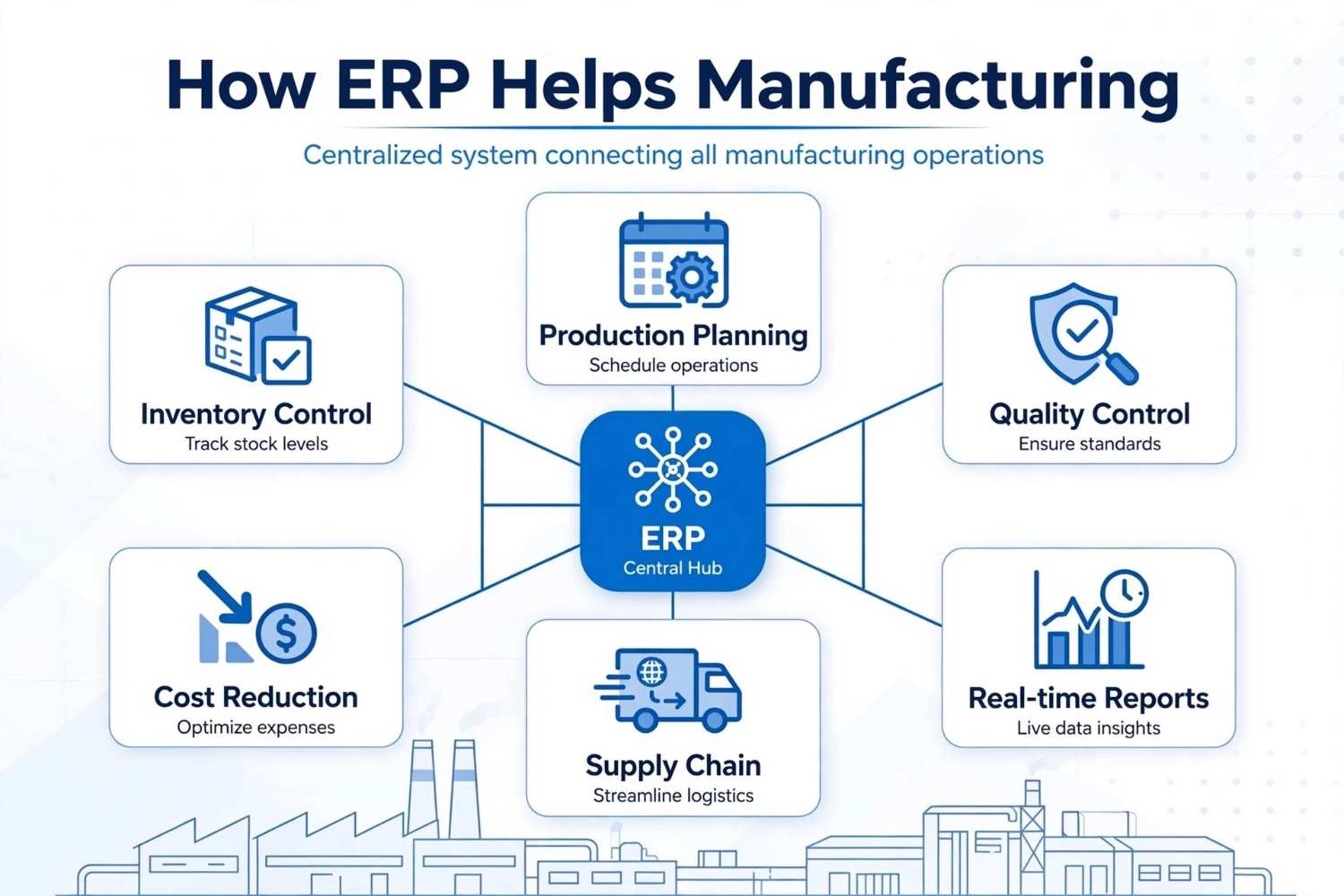
Manufacturing businesses have to manage many moving parts at the same time. Raw materials need to arrive on schedule, production must stay on track, machines need regular maintenance, inventory has to be controlled, employees need proper coordination, and finished products must reach customers on time.
When these activities are managed using spreadsheets, paper records, or separate software systems, it becomes difficult to maintain accurate information. A small mistake in inventory, purchasing, or production planning can create delays throughout the business.
This is where ERP for manufacturing businesses becomes valuable.
ERP, or Enterprise Resource Planning, connects important business functions such as production, inventory, purchasing, sales, finance, supply chain, and quality management in one integrated system. Modern manufacturing ERP systems are designed to provide a unified view of operations, automate manual processes, and help businesses make faster decisions using reliable data.
For a growing manufacturer, ERP is not simply another software investment. When implemented properly, it can become the digital backbone of the business.
What Is ERP for Manufacturing Businesses?
A manufacturing ERP system is software designed to manage and connect the major processes involved in manufacturing operations.
It can help businesses manage:
- Production planning and scheduling
- Material Requirements Planning (MRP)
- Bill of Materials (BOM)
- Raw materials and inventory
- Purchasing and suppliers
- Warehouse operations
- Quality control
- Sales and customer orders
- Financial management
- Machine maintenance
- Employee and workforce information
- Reports and business analytics
The main idea is simple: instead of different departments maintaining separate information, ERP creates a connected environment where authorized users can access consistent business data.
For example, if a customer places a large order, the system can help the business check available inventory, calculate material requirements, review production capacity, and plan the order. This connection between demand, materials, production, and finance is one of the major reasons manufacturers use ERP.
Why Do Manufacturing Businesses Need ERP?
Manufacturing operations are becoming more complex. Companies are dealing with changing customer demands, supply chain disruptions, rising operating costs, stricter quality requirements, and pressure to deliver products faster.
Traditional systems often create information silos. Production may have one spreadsheet, the warehouse another, while finance uses completely different software.
This creates questions such as:
How much stock do we actually have? Which orders are pending? Do we have enough raw material? How much did this product really cost to manufacture? Why is production delayed?
ERP helps answer these questions by bringing important information together.
| Common Manufacturing Problem | How ERP Helps |
|---|---|
| Production delays | Better planning and scheduling |
| Stock shortages | Real-time inventory visibility |
| Excess inventory | Improved material planning |
| Manual data entry | Workflow automation |
| Supplier delays | Centralized procurement tracking |
| Quality issues | Quality monitoring and traceability |
| High production costs | Better costing and resource visibility |
| Slow reporting | Real-time dashboards and reports |
1. ERP Improves Production Planning
Production planning is at the heart of every manufacturing business. If production is poorly planned, machines may remain idle, workers may be underutilized, and customer orders may be delayed.
Manufacturing ERP software helps businesses plan production based on customer demand, available materials, production capacity, work orders, and schedules.
MRP functionality can help determine what materials are required and when they are needed. Modern ERP platforms can also connect planning with real-time operational information, helping manufacturers adjust when conditions change.
For example, if a factory receives an unexpected bulk order, management can use ERP information to understand whether existing materials and production capacity are sufficient.
This makes production planning more organized and reduces avoidable bottlenecks.
2. Better Inventory Management
Inventory problems are common in manufacturing. Too much inventory increases storage and carrying costs, while too little inventory can stop production.
ERP provides businesses with better visibility into raw materials, work-in-progress inventory, and finished goods.
Instead of relying on manual stock registers, employees can track inventory movements through the system. This helps purchasing teams understand what needs to be ordered and allows production teams to know whether required materials are available.
Better inventory management can help reduce stockouts while preventing unnecessary overstocking. Manufacturing ERP platforms commonly combine inventory, procurement, and production information to support this type of control.
3. Reduces Manual Work
Manufacturing companies handle a large amount of repetitive information every day. Employees may need to enter purchase orders, stock movements, production details, invoices, delivery information, and other records.
Doing all of this manually takes time and increases the possibility of errors.
ERP software can automate many repetitive workflows. When information is entered into one part of the system, it can be made available to other connected processes.
This reduces duplicate data entry and allows employees to spend more time on productive work instead of administrative tasks.
4. Helps Reduce Manufacturing Costs
Cost control is one of the biggest priorities for manufacturers.
ERP software can help management understand where money is being spent across materials, labor, production, procurement, inventory, and other operations.
For example, if the actual material consumption for a product is consistently higher than expected, ERP reports can help management identify the difference and investigate the cause.
Similarly, accurate production and costing information can help businesses understand the profitability of individual products or orders.
The result is better cost visibility and more informed decisions about pricing, purchasing, production, and resource allocation.
5. Strengthens Supply Chain Management
A manufacturing company depends on its suppliers and logistics partners. If a critical raw material arrives late, the entire production schedule can be affected.
ERP helps connect procurement, inventory, suppliers, production, and logistics information.
Purchasing teams can track purchase orders, supplier deliveries, material requirements, and inventory levels from a centralized platform.
This provides better visibility into the supply chain and helps businesses respond faster when a supplier or delivery problem occurs.
Modern ERP is increasingly being used to improve supply chain resilience by connecting planning, procurement, inventory, and logistics information.
6. Improves Product Quality
Quality problems can become expensive very quickly. Defective products can lead to rework, material wastage, returns, customer complaints, and damage to the company’s reputation.
ERP can support quality management by maintaining inspection records, batch information, production details, and quality checkpoints.
Manufacturers can also use traceability features to track materials and components through different stages of production. This can make it easier to investigate quality problems and identify their source.
For industries where compliance and traceability are important, this capability can be particularly valuable.
7. Provides Real-Time Business Visibility
One of the biggest advantages of ERP is centralized information.
Managers do not always have to wait for different departments to prepare separate reports. Instead, they can access information about production, inventory, sales, purchasing, and finances through the ERP system.
This helps management understand what is happening across the business.
For example, a production manager can check the status of work orders, while a finance manager can analyze production costs and a purchasing manager can review material requirements.
This shared visibility can make decision-making faster and more accurate.
8. Improves Communication Between Departments
Manufacturing is not managed by one department. Production, purchasing, warehouse, sales, finance, quality, and management all depend on each other.
When departments work with separate systems, communication gaps can occur.
ERP creates a common platform where departments can work with connected information.
For example, the sales team can see relevant inventory information, purchasing can understand material requirements, and production can work from updated order information.
This reduces unnecessary back-and-forth communication and helps departments work toward the same goals.
9. Helps Manage Machines and Maintenance
Machine downtime can be costly for a manufacturing company. An unexpected equipment failure can stop production and affect delivery schedules.
ERP systems with asset and maintenance functionality can help businesses maintain equipment records, schedule maintenance activities, and track maintenance history.
Modern manufacturing ERP platforms can also support predictive maintenance when connected with appropriate operational data and technologies.
Instead of waiting for a machine to fail, businesses can plan maintenance activities more effectively.
10. Makes Order Management More Efficient
Customer orders move through several stages—from sales and inventory checks to production, packaging, and delivery.
ERP connects these processes so that businesses can monitor orders more efficiently.
When an order is entered, employees can determine product availability and, where necessary, identify the production and material requirements needed to fulfill it.
This can improve order accuracy and help customer service teams provide more reliable delivery information.
11. Supports Better Financial Management
Manufacturing and finance are closely connected.
Every purchase, production activity, inventory movement, sale, and employee expense affects the company’s financial performance.
ERP connects operational and financial information, helping businesses understand costs, revenues, margins, inventory value, and other financial indicators.
This gives management a more complete picture of business performance instead of looking at production and finance as completely separate activities.
12. Helps Manufacturers Make Data-Driven Decisions
Good decisions require good data.
ERP collects information from different departments and can turn it into reports, dashboards, and performance indicators.
Manufacturers can monitor metrics such as:
| KPI | Why It Matters |
|---|---|
| Production output | Measures manufacturing productivity |
| Inventory turnover | Shows how efficiently inventory is used |
| On-time delivery | Measures customer fulfillment |
| Machine downtime | Identifies equipment-related losses |
| Material consumption | Helps control wastage |
| Production cost | Supports profitability analysis |
| Supplier performance | Helps evaluate supply reliability |
| Quality defects | Highlights production problems |
With this information, managers can identify trends, find bottlenecks, and take corrective action instead of relying only on assumptions.
ERP Helps Small, Medium and Large Manufacturers
ERP is not limited to large manufacturing companies. Cloud-based ERP and scalable solutions have made integrated systems more accessible to small and mid-sized manufacturers as well.
However, the requirements are different for every business.
A small manufacturer may primarily need inventory, purchasing, accounting, and basic production management. A larger manufacturer may require advanced MRP, multi-location operations, quality management, maintenance, supply chain planning, and complex financial controls.
The right ERP should therefore match the company’s current requirements while providing room for future growth.
Key Benefits of ERP for Manufacturing Businesses
The overall impact of ERP can be summarized in the following table:
| Business Area | ERP Benefit |
|---|---|
| Production | Better planning and scheduling |
| Inventory | Improved stock visibility |
| Procurement | Better purchasing control |
| Supply Chain | Improved coordination |
| Quality | Better inspection and traceability |
| Finance | More accurate cost visibility |
| Maintenance | Better equipment planning |
| Reporting | Faster access to business data |
| Employees | Less repetitive manual work |
| Customers | Better order and delivery management |
ERP and the Future of Manufacturing
Manufacturing is moving toward a more connected and data-driven future. Technologies such as IoT, artificial intelligence, automation, robotics, cloud computing, and advanced analytics are increasingly being integrated into manufacturing environments.
ERP can provide an important foundation for this transformation because it connects business processes and provides a consistent source of information.
Recent manufacturing discussions also emphasize that reliable, connected data is essential before businesses can gain meaningful value from AI and other advanced technologies. Fragmented data across ERP, manufacturing execution, and other systems can make digital transformation more difficult.
Modern ERP platforms are also increasingly incorporating AI capabilities for areas such as demand sensing, production scheduling, anomaly detection, predictive maintenance, reporting, and decision support.
Things to Consider Before Implementing ERP
ERP can provide significant benefits, but implementation should be carefully planned.
Businesses should first understand their existing processes and identify the problems they want the ERP system to solve.
Important considerations include:
- Business and manufacturing requirements
- Implementation cost
- Data migration
- Employee training
- Integration with existing systems
- Scalability
- Data security
- Vendor support
- Customization requirements
- Expected return on investment
Employee involvement is also important. A technically powerful ERP system will not deliver its full value if employees do not understand how to use it.
Conclusion
So, how does ERP help manufacturing businesses?
The answer goes far beyond simple automation. ERP connects production, inventory, purchasing, finance, quality, supply chain, and other business functions into a more unified operating environment.
It can help manufacturers plan production more effectively, reduce inventory problems, control costs, improve quality, monitor operations in real time, and make better business decisions.
For a growing manufacturing company, the real value of ERP comes from having the right information available at the right time. Instead of spending hours searching through spreadsheets or waiting for reports, teams can work with connected data and focus on improving the business.
ERP should not be viewed as a quick fix for every manufacturing problem. Successful implementation requires planning, clean data, employee training, process improvement, and management support. But when implemented correctly, ERP software can become a powerful foundation for manufacturing efficiency, scalability, and long-term growth.
Frequently Asked Questions
What is ERP in manufacturing?
ERP in manufacturing is an integrated software system that connects production, inventory, procurement, finance, quality, sales, supply chain, and other business processes in one platform.
How does ERP improve manufacturing efficiency?
ERP improves efficiency by automating repetitive tasks, improving production planning, providing real-time inventory visibility, reducing data errors, coordinating departments, and helping managers make data-driven decisions.
Can ERP reduce manufacturing costs?
Yes. ERP can help reduce costs through better inventory control, improved resource utilization, accurate costing, reduced manual work, better procurement, and reduced production inefficiencies.
Is ERP useful for small manufacturing businesses?
Yes. Small and medium-sized manufacturers can also benefit from ERP, particularly cloud-based solutions that can scale as the business grows.
What are the main ERP modules for manufacturing?
Common modules include production planning, MRP, inventory management, procurement, warehouse management, quality management, finance, sales, maintenance, and reporting.
Does ERP help with inventory management?
Yes. ERP provides centralized visibility into raw materials, work-in-progress, finished goods, and inventory movements, helping businesses maintain better stock control.
Can ERP integrate with manufacturing machines?
Depending on the ERP platform and implementation, it can integrate with shop-floor systems, IoT platforms, manufacturing execution systems, and other technologies to exchange operational data.